
How to Get Clarke County Court Records
Every Clarke County court record request starts with the right court. Skip the broad name search. The Clerk of Superior and State Courts holds the official civil and criminal filings for those two benches. Those filings cover Superior felony matters, State misdemeanors, State civil suits, calendars, and filed papers. Magistrate, Probate, Juvenile, Athens-Clarke Municipal, Winterville Municipal, and the federal courts run separate record systems. Send only a name, and the request can land at the wrong counter. It may come back empty. A file may still exist.
Try to describe the record as narrowly as you possibly can. Name the court and the case number. Give the party name as it appeared at filing, plus the filing or arrest date, the document type, and the copy format you want. A case search or PDF calendar may find the matter. But a document image, a plain copy, a certified copy, and an Open Records request each take a different route. Access runs through the official Clerk entry. Georgia Courts E-Access, PeachCourt, the courthouse counter, mail, phone, and court-specific custodians also work. Under the Georgia Courts e-file table, PeachCourt or GreenCourt is mandatory for Clarke State and Clarke Superior filings.
- Name the court. Separate Superior or State records from Magistrate, Probate, Juvenile, Municipal, or federal records before making a request.
- Start online. Use the Clerk's legacy Case Search entry or the Georgia Courts E-Access directory to select Clarke State or Clarke Superior. E-Access sends users to PeachCourt, which requires an account. The legacy page did not expose its fields during review, so date-range, judge, attorney, wildcard, status, and refresh controls are not promised. The Clerk also posts judge and court calendars as PDFs.
- Use the counter. For Superior or State inspection, copies, or filing questions, go to the Clerk in Room 450 at 325 E. Washington Street, Athens, GA 30601. Bring the case number, court, date, and document name when known.
- Send mail only after confirming scope and payment. The Clerk publishes P.O. Box 1805, Athens, GA 30603. Ask for the right copy type, return instructions, and current fee before sending a request.
- Call the Clerk. The number is 706-613-3190. Its menu routes criminal, civil, jury, and real-estate questions, but no published instruction promises a phone search or an emailed copy. No official docket-copy instruction located a fax, email, or drop-box request route.
- Use the lower-court route when needed. Magistrate offers online status, lobby searching, and a mail form; Probate has its own case-search site; Juvenile uses its Clerk and JCATS process; Athens Municipal and Winterville Municipal use their own clerk or city routes. Bogart's current municipal routing needs confirmation from Bogart City Hall.
- Use the right public-records route. Send a Georgia Open Records request for general ACCGov records, or send a court-file request to the actual court custodian. Federal cases belong in PACER or the Middle District route, not the county Clerk's register.
Clarke County Magistrate Court Records
Magistrate Court runs its own records workflow. Its official Request for Records form supplies certified copies for Magistrate cases, takes cash, check, or money order, and asks for a self-addressed stamped envelope. Pick one of two rates. A certified copy of a single document costs $4.00. The entire file certified runs $14.00. Those prices come from the Magistrate form alone, not the Superior or State fee schedule.
The form's fields are practical identifiers. You give the civil or criminal case type, the party name at filing or arrest, the civil case number or warrant number, the filing or arrest date, the charge or subject, two mailing-address lines, and a telephone number. Traffic citations belong to Athens-Clarke Municipal Court instead. Misdemeanors and felonies that Magistrate did not resolve move to the Superior or State Clerk. The form has no government-issued ID field. It has no notary field, no email delivery option, and no turnaround promise. The official Clarke County forms hub posts the Magistrate request materials along with related Clerk forms.
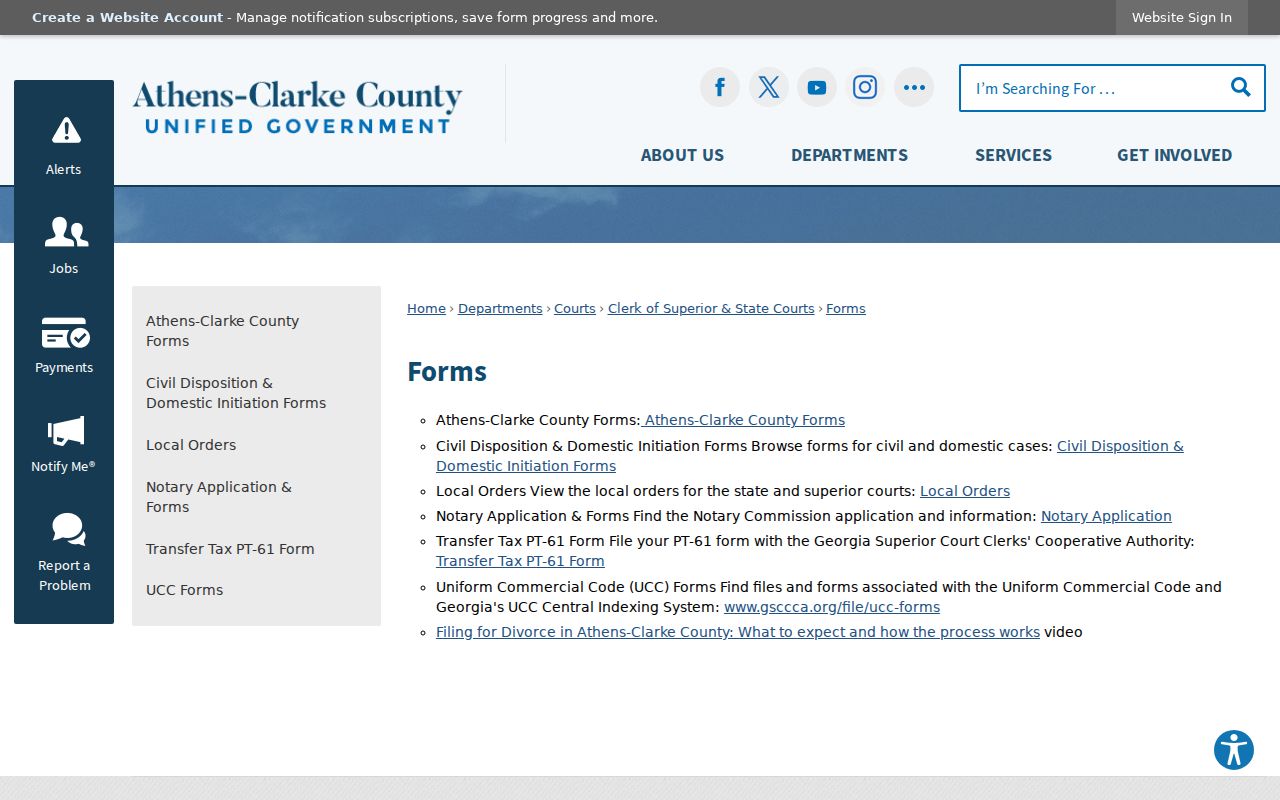
The forms hub is a handy way to check which court owns the paper before you mail a copy fee. A form meant for one clerk can never replace a request to a different court.
Types of Clarke County Court Records
Clarke County court records divide along the lines of whichever court created them. The Clerk of Superior and State Courts serves as the county's central records office for civil and criminal actions in the two main benches. A lower-court record can stay with its own clerk. That rule holds even after a case moves up. So the county's public systems each show one slice of a case. No single master file exists.
Type matters when you order a copy. A traffic payment page, a Probate case status, and a GSCCCA deed entry are each official for their own function. None of them substitutes for a Superior or State case file.
- Superior and State docket entries: case numbers, court information, filings, events, settings, status, and sometimes disposition for the civil and criminal actions those courts keep.
- Filed documents: complaints, answers, motions, orders, judgments, exhibits, calendars, transcripts, and other items linked to a case. A provider may charge separately for images.
- Magistrate records: warrants, preliminary criminal matters, small civil claims, dispossessories, garnishments, abandoned vehicles, and related limited matters.
- Probate records: marriage licenses, decedent estate records, and other civil filings within Probate's public-record scope, with older material scanned case by case.
- Juvenile records: delinquency, deprivation, and child-in-need-of-services matters, with statutory access limits even when filings use JCATS.
- Municipal, federal, and land records: Athens-Clarke, Winterville, and Bogart municipal records; federal PACER records; and property or deed records through Clerk land-record links and GSCCCA.
Plain Versus Certified Clarke County Records
A docket is an index-level view, not the whole file. Expect a case number, court, style, filing or open date, status, a run of dated events and settings, and sometimes a disposition. A filed document is one item in the case. It may be a complaint, answer, motion, order, judgment, exhibit, calendar, or transcript. A certified copy is a reproduction the Clerk certifies for a stated document, docket, or file request. Certification never lifts a missing or restricted item into an open one.
Watch the cost differences. PeachCourt may charge for document images. A free docket view shows only metadata. The official record controls whenever an online display falls short. Without a case number, a Clarke County case search can pin down the court before you pay for a copy. Ask the receiving court or agency first whether it needs a plain, electronic, certified, or restricted-access version.
| Record product | What it contains | Access point |
|---|---|---|
| Docket or case status | Index fields and chronological case events | Clerk search, PeachCourt, or a court-specific system |
| Filed document | A complaint, motion, order, judgment, exhibit, or other case item | Clerk file or provider document image, subject to access and charges |
| Certified copy | A copy marked and certified by the responsible Clerk | Request the exact document or docket from the custodian and pay the current schedule |
Clarke County Pre-1992 Court Records
Old Clarke County records take patience. Traffic files at Magistrate cover Dec. 31, 1960 through June 30, 1985, per the official records page. Criminal docket books are handwritten before Nov. 4, 1992. A computerized docket takes over after that date. One rule matters here. Files dated 1992 or older cannot be copied except docket books. That is an access limit, not proof a case never existed.
So a modern case search may miss an old entry that the courthouse still holds. Request a docket-book search. Give the court, the party name at filing or arrest, the case type, and a date range. Magistrate works through requests in receipt order. Timing depends on the file's age and location. If Magistrate never resolved the matter, the final-disposition court may hold the record instead.
What a Clarke County Court Record Contains
A Clarke County court record reads in layers. The case number ties the file to its court. The style names the parties. The filing or open date marks the start, docket events trace the sequence, and settings show when a matter hit a calendar. Status and disposition report what the case record says at that stage. Note one limit. A docket entry does not guarantee that its linked document image is public, complete, or certified.
The same field can mean more or less depending on your request. A party name may find a case. Pairing a case number with the court name cuts down error. A calendar setting shows a scheduled event without proving the event happened. And a disposition can sit in the docket. The signed order stays a separate filed document.
| Case number | The identifier assigned to the case and the best key for a narrow request. |
|---|---|
| Court | The Superior, State, Magistrate, Probate, Juvenile, Municipal, or federal court that keeps the record. |
| Style | The indexed case caption or party description attached to the action. |
| Filing or open date | The date that places the action in the court's record history. |
| Docket events | Chronological entries showing filings, actions, and other case activity. |
| Settings and calendars | Hearing or calendar information that may also appear in a judge-specific PDF. |
| Filed documents | Complaints, answers, motions, orders, judgments, exhibits, calendars, transcripts, and related items. |
| Status or disposition | A case-status label and, when reported, the case's disposition or outcome entry. |
Probate and Juvenile Clarke County Court Records
Probate runs its own public-record scope and its own case-search route. Marriage licenses date from 1934, decedent estate records from 2005, and other civil filings sit in the online public-record set. Older material gets scanned case by case. The Probate page warns that online information is not comprehensive and that sealed cases require contacting the Clerk. The office is in Suite 200, at 706-613-3320. Start with the Probate Court page and its case-search home.
Juvenile Court stands apart again. It hears delinquency, deprivation, and child-in-need-of-services matters, and Georgia juvenile records generally carry access limits. From Feb. 1, 2026, most Juvenile orders and documents must be filed in person or through JCATS; new-case complaints and placement objections are the stated email exceptions. JCATS is a filing system, not a promise of public document access. The Juvenile Court page lays out the court and clerk route.
Certified Copies and Fees
Know the record type, then price the copy. The current Clerk schedule for Superior and State lists unassisted copies at $0.50 per page. Assisted or mailed copies run $1.00. Certification runs $2.50 for the first page plus $0.50 for each extra page. Add $2.00 for a court seal or signature. Computer printouts cost $2.50 per page, and electronic or fax copies cost $2.50 for the first page plus $1.00 per extra page.
Pay by certified bank check, money order, cash, Visa, or Mastercard. Personal checks are not accepted at the Superior or State office. The current page lists no separate Superior or State docket-search fee. So ask before a broad search. PeachCourt vendor charges sit outside the Clerk's routine copy schedule. Magistrate has its own $4.00 and $14.00 choices. Those amounts should not be blended with Clerk charges.
| Item | Current amount or condition |
|---|---|
| Unassisted copy | $0.50 per page |
| Assisted or mailed copy | $1.00 as listed on the schedule; confirm the unit for a large request |
| Certified copy | $2.50 first page plus $0.50 each additional page |
| Court seal or signature | $2.00 |
| Computer printout | $2.50 per page |
| Electronic or fax copy | $2.50 first page plus $1.00 each additional page |
| Payment | Cash, Visa, Mastercard, certified bank check, or money order; personal checks are not accepted |
Clerk of Superior and State Courts
325 E. Washington Street, Room 450
Athens, GA 30601
706-613-3190
Public hours: Monday-Friday, 8:30 a.m.-5:00 p.m.
The official Clerk fee schedule posts the current copy prices and payment rules that this records table follows.
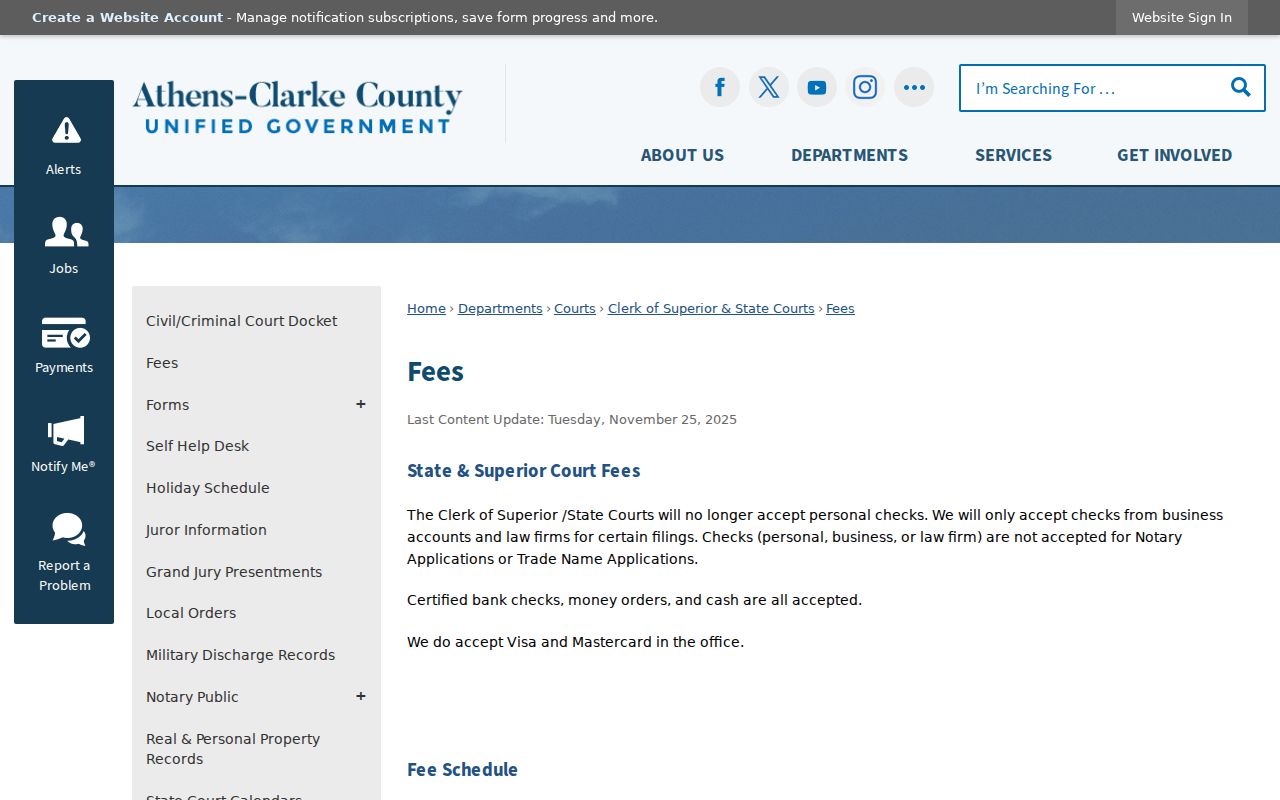
The schedule splits out ordinary copies, certification, seal or signature work, computer printouts, and electronic or fax delivery. Confirm the total before you mail payment.
Open Records and Clarke County Court Records
Georgia leans toward openness. Under O.C.G.A. §50-18-70, public records are open unless a specific exemption applies. A companion statute, O.C.G.A. §50-18-71, sets the rules for inspection and copying. It also covers how a request must be handled. You can ask orally. Writing is smarter, though, because it documents what you asked for and when. Expect an initial response within three business days. If the office needs more time, it should say so. It should also provide an estimate of fees where they apply.
Direct your Clarke County court records request to the office that actually holds the file. The Clerk of Superior and State Courts handles those case files. The Magistrate, Probate, Juvenile, and Municipal clerks each keep their own dockets. ACCGov open-records staff handle general government material, such as courthouse-project or administrative records. An ACCGov request cannot unseal a court file. If access is denied, keep the response and note the exemption the office cited.
The official Georgia request instructions walk through the state route. That route is for filing an Open Records request.
This route keeps a government-record request separate from a court-file request. The responsible custodian still controls the court record and any legal withholding.
For a mailed request, keep the description tight and hold on to the response.
- Name the actual custodian and court. Identify the Clerk of Superior and State Courts, Magistrate, Probate, Juvenile, Municipal, or ACCGov records office as appropriate.
- Give the case identifiers. Include the case number, party name, court, filing or arrest date, and a date range when known.
- Describe the exact item. State whether the request is for a docket or register, a particular filed document, a full file, or a certified copy.
- Choose the format. Say plain, electronic, certified, or restricted-access review, and provide the return address and phone number needed for the response.
- Confirm payment and timing. Ask for current fees before mailing. Keep the request and response together; the initial response is due within three business days or should explain the estimate.
Rule 21 and Clarke County Court Records
Uniform Superior Court Rule 21 begins with openness. Restrictions come second, and only through the courts. Under Rule 21.1, a judge may limit access after a motion and hearing. The order must name the record or portion, give a reason, and state how long the limit lasts. Rule 21.2 sets the balance: privacy harm must clearly outweigh the public's interest in access. A temporary ex parte restriction has its own leash in Rule 21.3. It is capped by the rule's stated 30-day limit. Rules 21.4 and 21.5 then supply the review and amendment paths. Rule 21.6 handles redaction of protected identifiers, working alongside O.C.G.A. §9-11-7.1.
Rule 21 access boundary: A restricted entry may leave a case shell, a limited event, or no document image in a public search.
Redaction can protect Social Security or tax numbers, financial-account information, and limited birth-date or identifier fields. Do not republish personal identifiers from a public PDF.
Rule 21 controls court-record access. A general Open Records request does not override a sealing or redaction order.
Some Clarke County court records sit behind special rules. Juvenile files are closed in most situations. Protective-order papers can hold safety details the court keeps private. Military-discharge filings deserve extra caution. The Clerk fee schedule lists DD214 filing at no charge. Yet the Georgia exceptions material places DD214s under O.C.G.A. §15-6-72(c)(1) protection for the statutory period. So a docket result marked restricted is not an expunged or destroyed record. It still exists.
The official Georgia open-government access guidance spells out more shielded categories: medical, insurance, bank or credit-card, and home-address information in relevant public-record settings.
Access rules explain the gap. A Clarke County court record can stay on file while the public copy stays limited, redacted, or offline.
Public Access and Sealed Records
Public access is not one switch for every Clarke County record. A public Superior or State docket can show events while holding back a document image. A limited case shell can appear with the restricted event missing. Probate warns that its online information is not comprehensive. And a Juvenile filing through JCATS never makes the case public. Even a no-result screen has many causes: the wrong court, an old handwritten record, something not yet indexed, a restricted case, or a portal failure.
Need a restricted item? Ask the responsible Clerk which motion, court order, or exception controls it. Do not hunt for a workaround through another portal. Start with the court-specific office, then name the exact document or docket you want. When another court or agency needs the record, confirm the copy type. It may take a plain copy, a certified copy, a seal or signature, or a restricted-access review. For a general Open Records request, the Attorney General's open-government guidance states that the first 15 minutes of search and retrieval go uncharged. It also states that law caps per-page copying. The Clerk's schedule controls routine court copies.
Sealed or protected access depends on the record and the office holding it, not just the search result. No single public list gathers every sealed Clarke County case or every redaction code.
Clarke County Land and Court Records
Land records run on a separate index. The Clerk's land-record pages cover 1962-1988 and link to GSCCCA for real-estate and deed recording. GSCCCC eFile is a property-record route, not the public Superior or State case docket. So a deed, lien, plat, or other real-estate instrument belongs with land records. A complaint, judgment, motion, or order tied to litigation stays with the court record keeper instead. Naming the record first prevents a costly detour.
The Clerk also handles notary, business-name, and military-discharge work. Those links do not replace a case search, though. Online courtesy views can be incomplete, and a vendor image is never a certified copy. For official use, tell the Clerk the exact document. Ask whether a certification, seal, or signature is required. If online sources clash, the court or Clerk holding the original controls.
Note: a property index, a docket entry, a filed document, and a certified copy are separate record products. Their custodians and access rules differ.